Dr. Rahul Chauhan
Specialist in shoulder, knee, spine endoscopy and ultrasound guided orthopedic procedures.
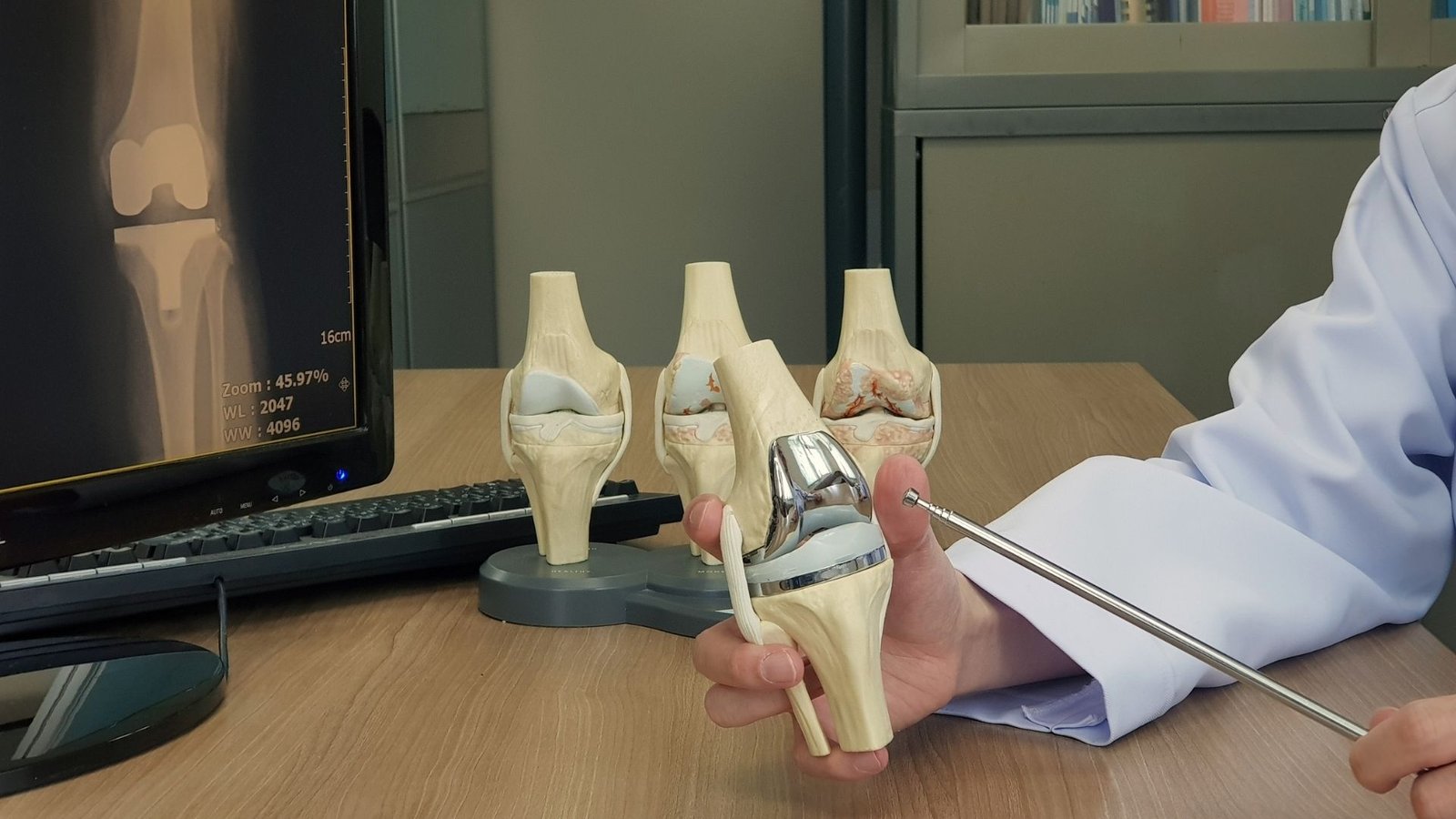
Total Knee Replacement (TKR) is a surgical procedure performed to relieve severe knee pain and stiffness caused by advanced arthritis, most commonly osteoarthritis. The goal of the surgery is to replace the damaged joint surfaces with an artificial implant, allowing patients to walk comfortably again and return to an active lifestyle.
When medicines, exercises and injections no longer provide lasting relief and knee pain begins to interfere with daily life, knee replacement becomes a reliable and time-tested solution.
At our centre, we focus on advanced, muscle-sparing and outcome-focused knee replacement techniques to ensure that patients recover faster and experience a natural-feeling knee after surgery.
Dr. Rahul Chauhan, trained through a specialised fellowship in knee and shoulder surgery, brings expertise in modern surgical approaches that prioritise patient comfort, muscle preservation and long-term performance of the implant.
While most knee replacement surgeons use the medial parapatellar approach — which involves cutting through the extensor mechanism (quadriceps tendon) — this method can result in greater postoperative pain and delayed rehabilitation.
At our centre, we routinely use the Subvastus Approach, in which:
Why it matters for patients:
This technique is especially beneficial for elderly patients, high-demand individuals and anyone who wants a quicker and more comfortable recovery.
The knee joint has three compartments:
Many surgeons replace only the medial and lateral tibiofemoral compartments. This leaves the patellofemoral compartment untreated.
To provide the best functional outcome, we replace all three compartments in most of our patients.
Advantages for patients:
By combining:
Our knee replacement focuses not just on pain relief, but on restoring natural knee biomechanics, faster recovery and long-lasting patient comfort.
Knee replacement is usually recommended for patients who have:
Most patients who undergo the surgery are above 55 years, but younger patients with severe arthritis may also benefit.
In arthritis, the smooth cartilage covering the bones inside the knee gradually wears away. As the cartilage becomes thinner, bones start rubbing against each other, leading to:
Over time, even simple movements like walking or getting up from a chair can become difficult.
Patients requiring knee replacement have to get routine blood investigations done and a pre-anaesthetic checkup is done before admission. All relevant x-rays are performed before admission and accordingly the choice of implant is discussed with the patient.
Knee replacement is done under spinal or general anaesthesia.
A simplified overview of the procedure:
The artificial joint is designed to move smoothly — just like a natural knee — and to last many years.
The type of implant is selected based on the patient’s age, bone quality, activity level and deformity. Options include:
Your surgeon will recommend the most suitable implant for your knee.
Patients commonly experience:
For many people, knee replacement dramatically improves quality of life.
Most patients stand and walk with support within 24 hours of surgery.
Typical recovery timeline:
| Time | Progress |
|---|---|
| 1–2 days | Walking with support |
| 2–3 weeks | Stitches removed / reduced pain |
| 3–6 weeks | Resuming daily routine activities |
| 6–12 weeks | Driving and light exercises |
| 3 months | Comfortable walking without support |
| 6 months | Full functional recovery for most |
Physiotherapy is essential to achieve strength, balance and full knee motion.
Modern knee implants are designed to last 15–20 years or more, depending on:
Although it varies from patient to patient but usually the knee replacement with good imported implant at our center in Meerut costs between 1.5 to 2 lacs. This is very economical as compared to other places nearby.
Total Knee Replacement is a trusted and effective solution for severe knee arthritis that no longer responds to medicines or physiotherapy. With the right surgical technique and dedicated rehabilitation, patients can regain pain-free mobility, independence and an active lifestyle.